


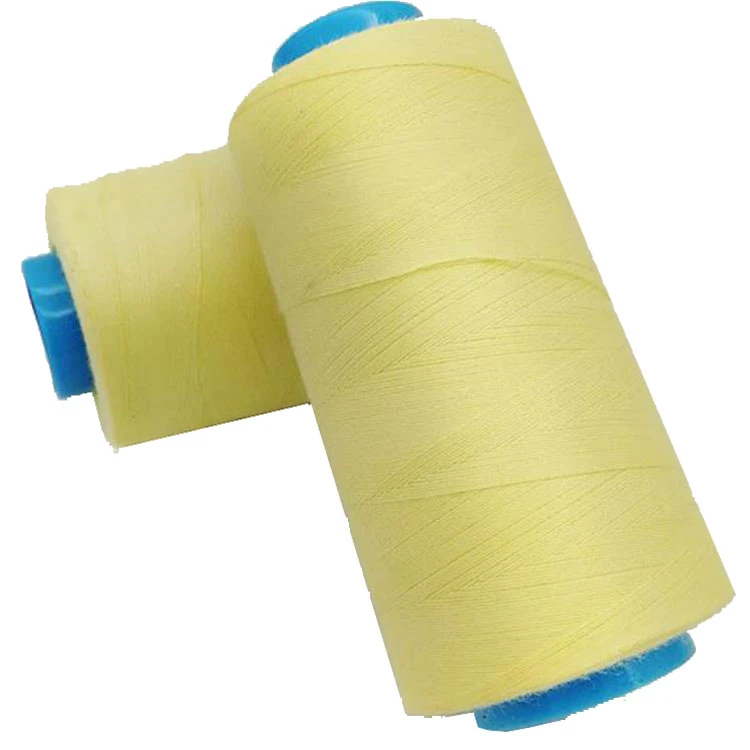
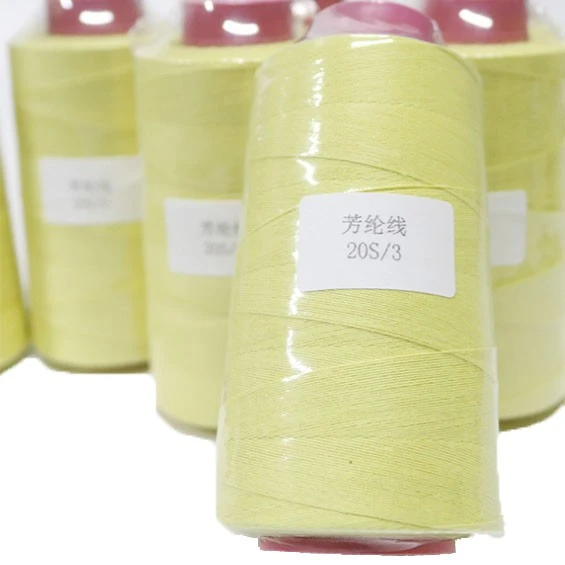

Customizable Aramid Sewing Thread 200g
Application: Hand Knitting, Knitting, Sewing, Weaving
We offer two ranges of technical-use threads: para aramid thread and meta aramid thread
Para aramid threads can continuously withstand 170 °C. they are used in many technical fields:
Ballistics (bullet-proof vests)
Safety shoes
Protective clothing: heat resistant, flame resistant, cut resistant (gloves, loggers' trousers)
Composite materials
Air dust extraction filters (hot gas filtration)
Tyres (reinforcement)
Meta aramid threads are particularly suitable due to their thermal protection, thanks to their self-extinguishing properties and a continuous application temperature of 220 °C. A highly technical thread, they are used for particularly targeted purposes:
●Heat and flame resistant clothing, textiles and stitching
●Safety shoes
●Protective gloves
●Aircraft seats
●Airbags
●Tapes
The comparison of meta aramid and para aramid spun yarn:
|
Item |
Composition |
Yarn count |
Strength |
Main Features |
Long-term usage temperature |
Carbonization temperature |
|
Meta aramid yarn |
100% meta aramid |
20S-40S/1-3strands |
500CN |
Fire & heat resistance |
220℃ |
400℃ |
|
Para aramid yarn |
100% para aramid |
20S-40S/1-3 strands |
3700CN |
High strength , high modulus. |
150-200℃ |
560℃ |
Feature introduction:
High strength: The characteristic strength can reach more than 20.0CN/dtex, which is five times that of steel and more than two times that of general organic chemical fiber materials;
Low density: much lower than steel, only 1/5 of the density of steel;
Good heat resistance: under the environmental conditions of 130°C, there is basically no loss of strength. It can be used normally at 200°C. Carbonization does not occur until around 427°C and decomposes above 500°C, with no melting point;
Corrosion resistance: It will only be affected by long-term exposure or use in high-concentration acid-base environments;
UV stability: Long-term exposure to UV light can cause a loss of mechanical properties, the extent of which depends on wavelength, exposure time, radiation intensity and product geometry.